Feeds:
Posts
Comments

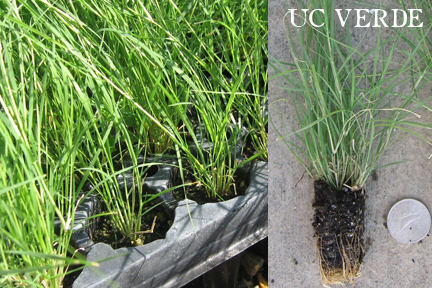
UC Verde Buffalo Grass does go dormant in the cold winter months, typically here in California that means from November to around February. Although it loses its color, it also means months of absolutely no maintenance – no mowing and no watering needed! But if you’d like to keep the appearance of a green lawn all you have to do is apply a grass colorant and it’ll last for up to 13-14 weeks! It’s pretty inexpensive, all you have to do is mix the solution with water, spray it on and let it dry. You can easily control how deep of a green you’d like by increasing the water to colorant ratio. Contact us for our recommendations at info@ucverdebuffalograss.com or 559-275-3844 or visit www.ucverdebuffalograss.com

img_5138-copy

Below is an area in our trial garden which has not been watered since last November! That’s 6 months of no water or maintenance of any kind!!! On the bottom half of the image you can see where the grass has been mowed back and the color has already returned to the lawn now that spring is here.

img_5133-copy

UC Verde Buffalo Grass is extremely drought tolerant using up to 75% less water. Did you know that approximately 50-70 percent of our residential water is used for landscaping, most of it to water lawns, which total approximately 20-30 million acres in the United States. With all of our drought issues here in California that’s a huge amount of water to be unneccessarily wasting. The grass does go dormant in the cold winter months, but that can be addressed by using a grass colorant which will last up to 13-14 weeks and looks pretty realistic. A small draw back to all the savings you’ll incur in water and money.

ucverde

A new grass we are now carrying is Bella Bluegrass. Though not as drought tolerant as the UC Verde Buffalo Grass, it also uses less water and it does not go dormant. The great thing about the Bella Bluegrass is it’s low maximum height of just 3-4 inches tall. Which means less or even no mowing required, saving the environment from air pollutants caused by lawn mowers and also saving you lots of time! Did you know that the use of gas-powered lawn mowers contributes five percent of the nation’s air pollution. A gas-powered lawnmower emits 11 times the air pollution of a new car.

Both varieties are available now! Contact us to learn more or to place an order.

bellanew

Article from the National Wildlife Federation:

“…Beginning in the 19th century, however, suburban Americans took to lawns like fish to water – and both fish and water have been adversely impacted ever since. Approximately 50-70 percent of our residential water is used for landscaping, most of it to water lawns, which total approximately 20-30 million acres in the United States. And the U.S. Environmental Protection Agency (EPA) estimates that nearly 70 million pounds of active pesticide ingredients are applied to suburban lawns each year, helping to make polluted runoff the single largest source of water pollution nationwide, affecting ground water, lakes and streams, wildlife, and human health. A 1995 EPA compilation of state data collected in 1994 showed that urban runoff contributed to damage in more than 26,000 river and stream miles. And the use of gas-powered lawn mowers contributes five percent of the nation’s air pollution. A gas-powered lawnmower emits 11 times the air pollution of a new car. The average American homeowner spends 40 hours a year mowing the lawn. Maintaining the “perfect” lawn – close-cropped, green, weedless, insect-free – requires our own time and energy (consider those blue-sky summer weekends spent mowing, edging, and moving hoses!), vast amounts of natural resources such as water and oil, and the use of a wide array of poisonous chemicals…”

UC Verde Buffalo Grass is extremely drought tolerant using up to 75% less water. It does however go dormant in the cold winter months, but that can be addressed by using a grass colorant which will last up to 13-14 weeks and looks pretty realistic. A small draw back to all the savings you’ll incur in water and money.

ucverde

A new grass we are now carrying is Bella Bluegrass. Though not as drought tolerant as the UC Verde Buffalo Grass, it also uses less water and it does not go dormant. The great thing about the Bella Bluegrass is it’s low maximum height of just 3-4 inches tall. Which means less or even no mowing required, saving the environment from air pollutants caused by lawn mowers and saving you lots of time!

Both varieties are available at www.ucverdebuffalograss.com

bellanew

Positive customer review!

“I can’t believe we continue to plant grass (fescue)  till I read about the benefits. Grasses to absorb carbon from our air and help moderate the tempertures around our homes. Plus they help keep the dust down as compared to having just dirt. I did some research and planted UC Verde and though  it did take some time to established itself compared to sod the water and mowing savings in the future will more that offset the time. If we can save 50-75 % on water what impact would that have for California. After growing the grass and seeing how nice it looks once established I have no complaints. Except that it does go dormant during the winter for a few months. But with the future water challenges it’s a small sacrafice.”

Did you know?

Did you know:


There is only 2.75% of fresh water on our planet with about 1% available for us to use.


Because of our current drought there will be approx. 100,000 acres that will go unplanted here in the Central Valley of California. This will cause the lost of 60,000 Ag and Ag Related jobs.


Over 50% of a home water usage is devoted to watering the grass. This is crazy. UC Verde Buffalo Grass uses up to 75% less water than a fescue. For every acre of fescue that means savings of roughly one million gallon of drinking water per year. In our trial plot we have not had to water our established planting yet. It is April 24th and we’re located in Fresno, California, where it’s hot and dry. Imagine if eveyone in California did the same, how much water and pollution we would save our environment. Plus with buffalo grass we are not creating a heat island effect as you have with artificial grass.


The future for California landscape is in this grass that UC Davis and UC Riverside developed for California. We are growing grass using our future water supplies. Think about that.


To learn more about UC Verde Buffalo Grass or Bella Blue Grass visit us at www.ucverdebuffalograss.com

The City of Los Angeles is enacting water restrictions for its residents. The Emergency Water Conservation Plan or Ordinance 180148 states that voluntary conservation efforts have proved insufficient and now a mandatory conservation plan will take effect. Effective immediately is a list of regulations for the use of water as well as restricting the watering of lawns to 2 days a week and no more than 10-15 minutes per day. Violations will result in increasing fines added to your water bill. Email us at info@ucverdebuffalograss.com for a copy of this ordinance.


To learn more about UC Verde Buffalo Grass or Bella Blue Grass visit us at www.ucverdebuffalograss.com

The Lazy Gardener wrote to us:

“Because there is so little information on how this grass grows in Phoenix, I decided to make it part of my new gardening blog. If it thrives or dies, it’s going to happen, with pictures, on the internet. So far, it’s still alive and starting to spread.”

Click here to see more: http://lazygardens.blogspot.com/search/label/buffalo%20grass

To learn more about UC Verde Buffalo Grass or Bella Blue Grass visit us at www.ucverdebuffalograss.com

A Better Grass

(Posted in the Opinion section of the Fresno Bee, 3/7/09, by Don H. Gaede of Fresno)

This three-year drought requires us to start thinking differently about our lawns. Sure, they look beautiful. But they suck up an awful lot of water and chemicals, they require weekly mowing and edging and the lawnmowers foul our air.

Citizens of California, it is time for a better lawn – one invented right here at the University of California Davis and UC Riverside. This lawn requires up to 75% less water (a quarter-inch once a week) and only needs to be mowed once a year.

It is called UC Verde Buffalo Grass, and it is available in Fresno. UC Verde is custom-made for this Valley and this drought.


To learn more about UC Verde Buffalo Grass or Bella Blue Grass visit us at www.ucverdebuffalograss.com

(paraphrased from an article in the Fresno Bee, 2/28/2009, By Denny Boyles and Mark Grossi)

If rains don’t end drought, city may require residents to cut their use by 25%

Unless March brings record rainfall, Fresno will be forced to impose new water restrictions on residents and businesses this summer, city officials say. The state’s three-year drought already has devastated Valley agriculture. The city is making plans to declare mandatory cuts of 25%. That could mean no washing cars with a hose, tightened irrigation rules and stepped-up enforcement by the city.

Fresno has already moved to “Stage 1” of its drought plan, which calls for voluntary 10% cuts in water use, said Lon Martin, assistant director of public utilities for Fresno.

“Stage 2” would mean mandatory reductions of 25%. Further stages could mean more drastic cuts.

Gov. Arnold Schwarzenegger declared a drought emergency after three years of below-average rain and snow in California. “This is a crisis…and we must treat it with the same urgency…”, he said.

Three dry winters have left California’s state and federally operated reservoirs at their lowest levels since 1992.

“The situation is extremely dire,” said Tim Quinn, executive director of the Association of California Water Agencies.